
Why Do I Keep Overthinking? The Anxiety Cycle No One Talks About
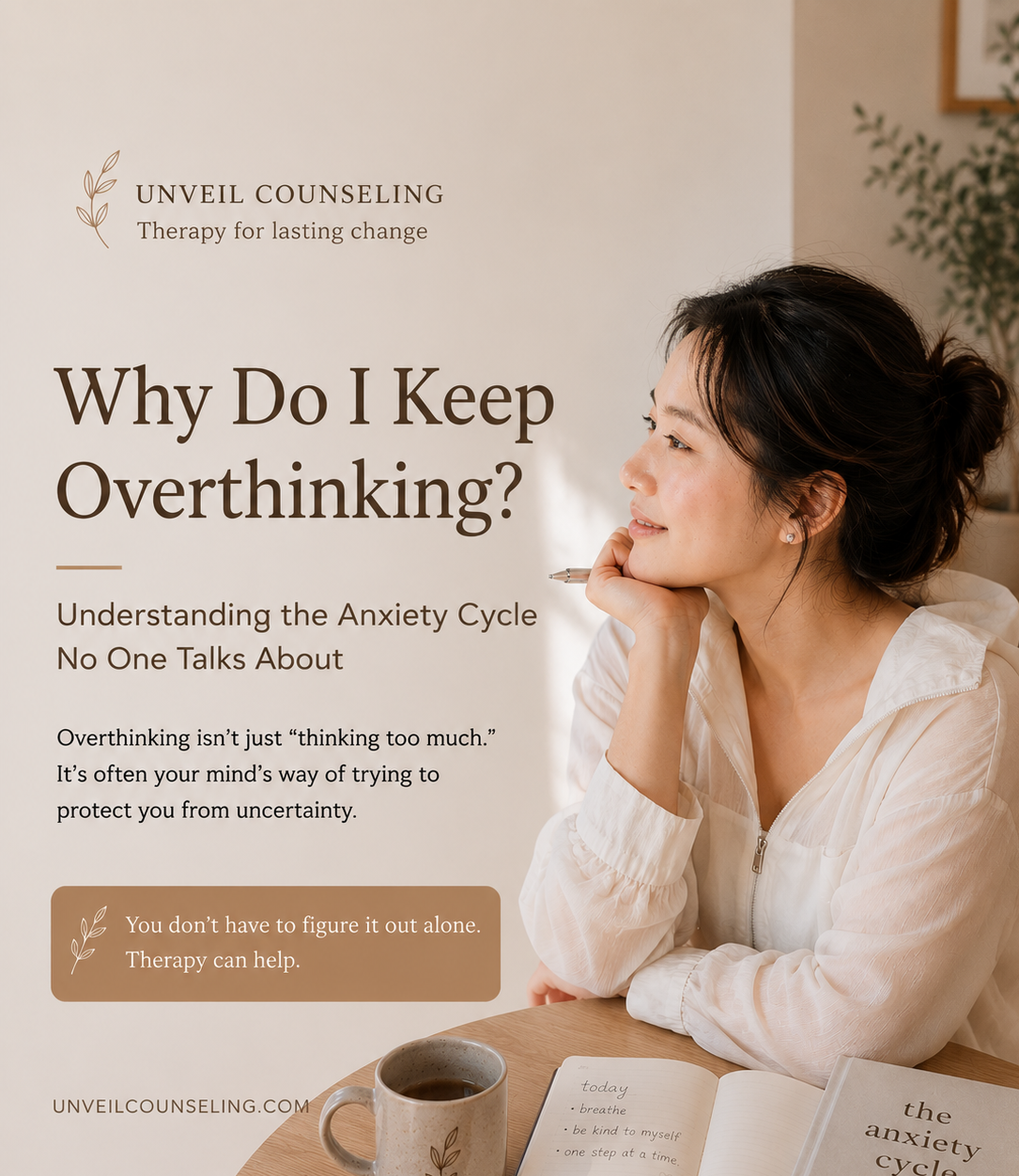
"I know I'm overthinking... I just don't know how to stop."
It's something I hear often in therapy.
People usually aren't looking for more advice.
They've already tried telling themselves to "let it go."
They've distracted themselves, stayed busy, and reminded themselves they're probably worrying for no reason.
But their mind keeps coming back anyway.
If this sounds familiar, there's a good chance you're not choosing to overthink.
Your mind is trying to do something it believes is important.
Your Mind Isn't Trying to Torture You
It might feel like your brain is working against you.
Replaying conversations.
Imagining every possible outcome.
Analyzing one text message over and over.
Wondering if you said the wrong thing.
But overthinking usually isn't your mind trying to make you miserable.
More often, it's your mind trying to protect you.
If it can think through every possibility, maybe nothing will catch you off guard.
Maybe you won't make a mistake.
Maybe you won't get hurt.
The problem is, certainty never arrives.
So your mind keeps searching.
The Search for Certainty Never Ends
Overthinking often sounds like:
"What if I missed something?"
"What if they're upset with me?"
"What if I make the wrong decision?"
For a moment, thinking feels productive.
It feels like you're solving a problem.
But after a while, you notice something frustrating.
You're thinking more...
and understanding less.
Instead of feeling calmer, you feel even more overwhelmed.
Sometimes Overthinking Starts as Self-Protection
For some people, overthinking develops after painful experiences.
Maybe you grew up needing to pay close attention to other people's moods.
Maybe making mistakes wasn't safe.
Maybe you learned that if you could anticipate problems, you could avoid getting hurt.
If that's true, your mind isn't broken.
It's doing exactly what it learned to do.
The challenge is that what once helped you survive may now be keeping you stuck.
You Don't Need to Think Harder
One of the biggest myths about overthinking is that the solution is finding the "right answer."
But most of the time, you aren't missing information.
You're looking for certainty that doesn't exist.
The goal isn't to eliminate uncertainty.
It's to learn that you can handle uncertainty without your mind working overtime.
Therapy Isn't About Stopping Your Thoughts
You can't simply decide never to overthink again.
And that's okay.
Therapy isn't about forcing your mind to be quiet.
It's about understanding why it became so loud in the first place.
Together, we can explore the patterns underneath the overthinking, build awareness, and practice responding with more curiosity and compassion instead of fear.
You Are More Than Your Thoughts
If you've been overthinking for a long time, it may feel like your mind never gets a break.
But your thoughts don't have to control every decision you make.
With time, insight, and support, it's possible to step out of the cycle and create more space for calm, confidence, and self-trust.
You don't have to spend every day arguing with your own mind.
